Showing posts with label capsulitis. Show all posts

Monday, August 27, 2012

Capsulitis: Take Time Now and Get it Treated

English: Right knee.
Right knee. (Photo credit: Wikipedia)
Two bones coming together in the body form a joint. Joints are what allow the body to move. Capsular ligaments surround the joint. They are tough cord like structures that are similar in strength to tough leather. They hold the bones together in alignment and allow the joint to move within its appropriate range. Bones are tougher than ligaments and have strength more in the range of low grade steel. With ligaments holding the joint together, if a traumatic injury occurs, since the ligaments are the weaker of the two structures, they give way first. Faulty biomechanical structure can also cause stress that results in an injury.

Activities done every day may contribute to stress that leads to injury. Some of the day to day activities that you do that may be contributing factors include:
  • Stooping while gardening
  • Squatting down frequently
  • Climbing ladders
  • Working close to the ground or floor
  • Wearing high heels
All of these activities force the body into a position where the toes are excessively bent and a great deal of pressure is placed on the toes. Eventually, this constant overstretching occurs and capsulitis sets in. If the aggravating activity continues the injury becomes more serious and takes longer period of time to heal.

The pain caused by capsulitis is a continual nagging discomfort. At times the pain may closely resemble that of Morton’s neuroma, making it difficult or somewhat confusing to diagnose. A clear history of prior foot injuries, complaints and activities may assist Dr. Boucher with her evaluation, so a patient should be prepared to answer questions. You should contact Dr. Boucher if you suspect you have capsulitis.

Fortunately, there are conservative treatments that should help with the discomfort. These may include:
  • Oral anti-inflammatory medications
  • Cortisone injections
  • Topical analgesics
You need to avoid the aggravating activity as much as possible and protect your feet by wearing shoes that have a more durable sole. Avoid flip-flops, high heels, boat shoes, skimmers and flats. These shoes have flimsy soles and will not protect your feet. Call Dr. Boucher at (203) 238-3668 if you suspect you have capsulitis. A delay in treatment will worsen the condition and extend the recovery time.

References:

http://www.centralctfootcare.com/library/3763/Capsulitis.html
http://www.foot-pain-explained.com/capsulitis.html
Enhanced by Zemanta

Wednesday, June 23, 2010

Capsulitis and Your Foot

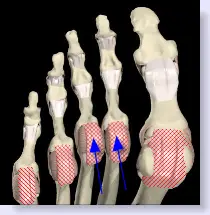
In our second toe, there are ligaments that surround the joints at the base of the toe, forming what are called capsules. Capsulitis is an inflammation of these capsules. While capsulitis can affect your third or fourth toes, it most commonly affects the second toe. Capsulitis can also be known as predislocation syndrome, due to the fact that if the condition is left untreated, it can lead to a weakening of surrounding ligaments and cause a dislocation of the toe.
Capsulitis in your foot is thought to be caused by abnormal foot mechanics, especially when the ball of the foot takes a great deal of weight-bearing pressure. Other conditions may predispose you to capsulitis, including bunion deformities, your second toe being longer than your big toe, an unstable arch of your foot, or a tight calf muscle.
Capsulitis is a degenerative disease and therefore should be treated as soon as you notice the condition. Symptoms in the early stages may include:
1. Pain in the ball of your foot, almost like there is a bunched up sock .
2. Swelling in the area.
3. Difficulty wearing or putting on your normal shoes.
4. Pain when in barefeet.
In more advanced cases, the affected toe may start to drift over to the big toe and cross over.
This condition may often be confused with Morton's Neuroma, which has similar symptoms, so it is crucial that you get an accurate diagnosis from a podiatrist. Your podiatrist will manipulate the affected area to produce symptoms and X-rays will be ordered.
Will you need surgery? Not if it is caught in the early stages before it crosses over. Once it has crossed over, the toe will never go back to its original place and will need to be surgically corrected. Things that can be done prior to that are:
1. Rest and Ice.
2. Anti-inflammatory medications, like ibuprofen.
3. Taping and splinting.
4. Stretching.
5. Shoe modifications.
6. Orthotic devices.
Always contact your podiatrist first when you think you have capsulitis in your foot!
Dr. Tina A. Boucher, DPM
Central Connecticut Foot Care, LLC
Meriden, CT Podiatrist
http://www.centralctfootcare.com/
Order your copy of our free books "Why Do My Feet Hurt?" and "Heal My Heel!" today!