Showing posts with label podiatrist in meriden ct. Show all posts

Monday, October 31, 2011

Orthotics: What Are They?

Orthotics are custom molded devices which are designed specifically for your feet and then placed in your shoes. They are intended to correct abnormal foot biomechanics. They perform functions that make standing, walking, and running more comfortable and efficient by altering the angles at which the foot strikes a walking or running surface. Doctors of podiatric medicine prescribe orthotics as a conservative approach to many foot problems or as a method of control after certain types of foot surgery; their use is a highly successful, practical form of treatment.
Orthotics take various forms and are constructed of various materials. They fall into three broad categories: those that primarily attempt to change foot function, those that are primarily protective in nature, and those that combine functional control and protection. Orthotics can be categorized as rigid, semi-rigid, and soft.
The so-called rigid orthotic device, designed to control function, may be made of a firm material such as plastic or carbon fiber and is used primarily for walking or dress shoes. It is generally fabricated from a plaster mold of the individual foot. The finished device normally extends along the sole from the heel to the ball of toes of the foot. It is worn mostly in closed shoes with a heel height under two inches.
The semi-rigid orthotic provides for dynamic balance of the foot while walking or participating in sports. Each sport has its own demands and each sport orthotic needs to constructed appropriately with the specific sport and athlete in mind. This functional dynamic orthotic helps guide the foot through proper functions, allowing the muscles and tendons to perform more efficiently. The classic semi-rigid orthotic is constructed of layers of soft materla, reinforced with more rigid materials.
The soft orthotic device helps to absorb shock, increase balance, and take pressure off uncomfortable or sore spots. It is usually constructed of soft, compressible materials, and may be molded by the action of the foot in walking or fashioned over a plaster impression of the foot. This orthotic usually extends from the heel past the ball of the foot to include the toes. The advantage of any soft orthotic device is that it may be easily adjusted to changing weight-bearing forces. The disadvantage is that it must be periodically replaced or refurbished.
Various other orthotics may be used for multidirectional sports or edge-control sports by casting the foot within the ski boot, ice skate boot, or inline skate boot. Combinations of semi-flexible material and soft material to accomodate painful areas are utilized for specific problems.
Only a licensed health care professional can diagnose and prescribe medical treatments, including orthotics. There are some outstanding over-the-counter products which your podiatrist may recommend as an interim treatment, but remember that you will want the advice of your doctor before buying these devices from a retail store, since wearing the wrong type of insert can be detrimental to feet, especially for people with diabetes or arthritis.
Dr. Tina A. Boucher, DPM
Central Connecticut Foot Care, LLC
Podiatrist Meriden CT
http://www.centralctfootcare.com/
Order your free copy of our books "Why Do My Feet Hurt?" and "Heal My Heel!" today! Copies will be sent to Connecticut residents only.

Friday, September 9, 2011

Boots Day by Day: Friday

Style: Trendy Ankle Bootie
Problem: Lack of ankle support coupled with a high heel can cause imbalance.
Solution: Select a heel no more than two inches in height and don't walk long distances.
Our recommendation: Clark's Vermont Terrace. Available through http://www.clarksusa.com/. $119.99

Dr. Tina A. Boucher, DPM
Central Connecticut Foot Care, LLC
Podiatrist Meriden CT
http://www.centralctfootcare.com/
Order your free copy of our books "Why Do My Feet Hurt?" and "Heal My Heel!" today! Copies will be sent to Connecticut residents only.

Thursday, September 1, 2011

Shoe of the Month: Clogs

Look past the tough exterior to find the softer side of clogs. Choose a pair with ultra-soft soles that provide cushioning, such as APMA-accepted Crocs, which are ideal for sufferers of plantar fasciitis, neuromas, bunions, hammertoes, or achy feet. The wide toe box also affords the front of the foot lots of room to move around, making it a very comfortable shoe inside and out. Our pick is Aetrex's Berries Clog, which comes in an astonishing 11 different colors. It has an anti-microbial lining to help prevent fungal and bacterial infections as well as memory foam to provide optimum comfort. It's also easy on, easy off thanks to the design of the Berry. Find this line and the rest of the Aetrex shoes sold exclusively in our office.
Dr. Tina A. Boucher, DPM
Central Connecticut Foot Care, LLC
Podiatrist Meriden CT
http://www.centralctfootcare.com/
Order your free copy of our books "Why Do My Feet Hurt?" and "Heal My Heel!" today! Copies will be sent to Connecticut residents only.

Thursday, August 18, 2011

Show Those Summer Toes!

With summer here, many of us are ready to shed those heavy shoes and socks in favor of sandals and flip-flops. But over the winter, corns and calluses many have developed, making your feet and toes not quite ready for "prime time". Help is on the way!
Corns and calluses are protective layers of compacted, thick, dead skin cells. They are caused by repeated firction and pressure from skin rubbing against bony areas or against an irregularity in a shoe. Corns ordinarily form on the toes, and calluses on the soles or the balls of the feet. Corns and calluses can also form when the position of the bones in your feet change. The corns and calluses initially form to provide protection, but as they thicken, they can become painful and inflamed.
The friction and pressure from both corns and calluses can cause a painful or burning sensation. Often one visit to the podiatrist can be all that's needed to relieve the pain, although most corns and calluses will reoccur without regular monitoring or changes in either your shoes or your foot function. The podiatric physician can work with you to relieve the pain by using a variety of pads or mateirals on the affected areas.
It is important that you never cut your corns or calluses with any instrument and never apply home remedies, except under a podiatrist's instructions. Many over-the-counter remedies are advertised frequently, but often these home remedies can be dangerous. Self-treatment can often turn a minor problem into a major one.
Corns and calluses can be particularly problematic for patients with diabetes. These patient should always schedule regularly yearly visits with their podiatrist to check for foot problems and circulation issues. If more frequent visits are required, the podiatrist will work with you to make sure your corns and calluses are monitored and treated as needed.
One way to control corns and calluses is to make sure that your shoes fit properly. Purchase new shoes later in the day when feet tend to be at their largest and replace worn out shoes as soon as possible. Select and wear the right shoe for the activity that you are engaged in (i.e. running shoes for running). Also, it is important to alternate shoes- don't wear the same pair of shoes every day.
A visit to your local podiatrist can be all you need to get your feet in shape for summer footwear, so schedule that now and be ready to show off your fancy feet!
Dr. Tina A. Boucher, DPM
Central Connecticut Foot Care, LLC
Podiatrist Meriden CT
http://www.centralctfootcare.com/
Order your free copy of our books "Why Do My Feet Hurt?" and "Heal My Heel!" today! Copies will be sent to Connecticut residents only.

Thursday, May 19, 2011

Get Your Feet Fit for Spring

With spring here, we are all looking forward to warming up our bodies for increased activity levels. To make sure that your feet are fit for spring, we offer the following suggestions.
*When starting a new exercise routine, or when ramping up your current one, make sure to ease into that new routine. Stretching before exercising is one way to make sure you are warmed up and ready to go.
*Consider purchasing new shoes for your new level of activity. It's important to have your feet measured, and then choose an athletic shoe that fits your sport. Make sure to break in any new gear appropriately, and ask your podiatric physician for recommendations for your particular needs.
*Take care of your feet. Examine them daily for signs of blisters, corns, and ingrown toenails. Take a few days off your new activity if you see signs of any of these problems.
*Visit your podiatrist periodically to discuss your foot and ankle concerns or just for a check-up before starting a new routine.
*Watch your sun exposure. As the weather improves and our feet are more exposed, it's important to remember sunscreen. The tops of feet are one of the most commonly sunburned areas.
*Seek immediate care for any foot or ankle problem.
Spring is a great time for renewal, but don't let your overeagerness get the best of you. Take the time to enjoy and take care of those two very important assests- your feet.
Dr. Tina A. Boucher, DPM
Central Connecticut Foot Care, LLC
Podiatrist Meriden CT
http://www.centralctfootcare.com/
Order your free copy of our books "Why Do My Feet Hurt?" and "Heal My Heel!" today!

Thursday, April 28, 2011

When to See a Podiatrist

Every local drugstore has aisles of "do-it-yourself" medical fixes. For your feet they have blister and corn pads, insoles, fungus sprays, and nail clippers. So when you have foot and ankle problems, how do you know when to deal with them at home using over-the-counter(OTC) products and when to see the podiatrist?
  • Blisters on your feet can often be handled at home without professional intervention. If the blister pops, cover it with a sterile dressing or Band-Aid and watch it carefully to make sure it heals properly.
  • If you suspect that you have an ingrown toenail, it is best not to use OTC products. See your podiatrist as soon as possible to avoid the possibility of infection. The doctor can safely remove the ingrown nail and may be able to alleviate the problem entirely for the future.
  • OTC wart removal medication is relatively mild but can cause ulcerations if left on too long. You can try to alleviate warts on the feet with these products, but the podiatrist has more effective medications and can also do simple procedures to rid you of warts. Wart removers should never be used if you have neuropathy except under the supervision of a podiatrist physician.
  • Despite numerous blogs and articles about treating onychomycosis (fungal nails) and warts with Vicks Vapo-Rub, duct tape, bleach, white vinegar, and other household items, there are no scientific data or evidenced-based research studies to support these treatment options.
  • Sprains and strains can be treated at home initially with the "RICE treatment"- rest, ice, compression, and elevation. If swelling is persistent, a visit to the podiatrist's office is in order to determine if there are any broken bones.
Occasionally, home remedies can cause a new problem or make existing problems worse, so use them all in moderation. Anyone with diabetes or a peripheral vascular disease (PVD) who has foot and ankle problems should always opt to visit the podiatrist for even minor concerns. People who do not have diabetes or PVD should also be wary of pain, color changes, drainage, swelling, heat, or open areas in or on any part of the foot or ankle. These signs warrant a professional's experience in dealing with the problem.

Dr. Tina A. Boucher, DPM
Central Connecticut Foot Care, LLC
Podiatrist Meriden CT
http://www.centralctfootcare.com/
Order your free copy of our books "Why Do My Feet Hurt?" and "Heal My Heel!" today!

Thursday, April 21, 2011

Fungal Nails: No More!

Fungal nails are an unsightly infection causing thickened, brittle, yellow, discolored nails, and can be sometimes painful. It is very difficult to cure. It is caused by one of several microscopic organisms, similar to those that cause Athlete's Foot (dermatophytosis). These are plant-like organisms that thrive in a dark, warm, moist environment, such as within shoes and stocking. They grow in the nail bed, beneath your nails, and live off Keratin, the protein in the nail. The condition usually begins toward the far end of the nail and may cuase white or yellow-white areas that appera to be rotten or dead. If the infection continues to the base of the nail, it can invade the nail root (matrix) and cause the nail to grow thickened and deformed. Many people complain of a foul odor associated with this condition. It can also spread to other nails.
Sweaty tennis shoes and moist socks create the perfect conditions for them. The fungi thrive in a warm, moist, dark environment and they eat protein keratin that our skin produces. Although fungi may be present in the skin around the nails, it may not develop a nail infection without history of injury, such as bruised toenails from short shoes, inflammation from an ingrown toenail, or from cutting the nails incorrectly or too short. In other words, the organisms do not invade intact, healthy, normal skin or nails. Other contributing factors would be excessive perspiration, and Dermatophytosis (Athlete's Foot), which is caused by similar fungi.
If left untreated, fungal nail infections can affect the entire nail and surrounding skin. Thankfully, there are several options available to rid your toes of unsightly and embarrassing colors or images. Formula 3 is as simple and easy as painting your nails. Oil-soluble, it gets through the nail bed and treats the fungus right away. Most people see a difference in their nails in 6 weeks. Dr.'s Remedy Nail Polish is similar to Formula 3, but is a nail polish with color options. There are a wide variety of colors and it hides unsightly nails during sandal season. SteriShoe Sanitizer is an option to rid your shoes of harmful bacteria. You may think it's enough to tret your feet, but you also need to treat your shoes as well. SteriShoe uses ultraviolet light to kill microorganisms in your shoes.

Dr. Tina A. Boucher, DPM
Central Connecticut Foot Care, LLC
Podiatrist Meriden CT
http://www.centralctfootcare.com/
Order your free copy of our books "Why Do My Feet Hurt?" and "Heal My Heel!" today!

Thursday, April 14, 2011

Common Women's Foot Problems

Let's admit it ladies. We abuse our feet. We put a lot of stress and strain on our lower extremities, and we don't take nearly as good care of them as we should. Based on our need to be fashionable, we often wear shoes that don't fit well or are just not designed for walking and standing for long periods of time. Even Oprah admits that she only wears her highest heels once she's seated during an interview. It's no wonder that those stilettos and peep-toes are causing us pain- they are designed for beauty, not comfort. Women have some of the same foot problems as men, but mostly, our feet have many more "issues".
Bunions are enlargements of the joint at the base of the big toe- the metatarsophalangeal (MTP) joint- that form when the bone or tissue at the big toe joint moves out of place. Bunions are a symptom of our foot's development due to the way we walk, our inherited foot type, our shoes, or for other reasons. Although bunions tend to run in families, it is the foot type that is passed down- not the bunion. Since the MTP joint carries much of the body's weight while walking, bunions can cause extreme pain if left untreated. Podiatric medical attention should be sought at the first indication of pain or discomfort.
Stress fractures are tiny or incomplete cracks in a bone often caused by overuse. Stress fractures occur most frequently in the foot and ankle and can be caused by a number of factors. An unusual increase in activity causing strain in the foot (fatigue fracture) is one of the most common causes, while weak bones (insufficiency fractures) are caused by medical conditions such as osteoporosis, can also be a factor. Medications such as steroids can lead to stress fractures, as can a sudden increase in activity levels. All of these causes can and should be evaluated by your podiatrist when you notice pain or swelling, which are the symptoms of a stress fracture.
A neuroma, also referred to as a "pinched nerve" is a painful condition involving irritation and/or thickening of the nerve tissue between the toes, most commonly the 3rd and 4th toes. The condition brings on pain, a burning sensation, tingling, or numbness between the toes and in the ball of the foot. Your podiatrist can offer a number of treatment options for a neuroma.
Ingrown toenails are a common ailment seen by podiatric physicians. An ingrown toenail is one whose corners or sides dig painfully into the soft tissue of the toe, often leading to irritation, redness, and swelling. Usually, toenails grow out straight, but sometimes one or both corners or the sides will curve and grow into the flesh. The big toe is the most common site for this condition, but other toes can also become infected.
Ingrown toenails may be caused by any one or more of the following: improperly trimmed nails, shoes that are too tight, trauma, and activities with repeated pressure on the toe (such as running or kicking). There are other causes as well, but this painful condition can usually be esaed with one or two visits to your podiatrist's office
Women may also have a tendency to develop blisters, corns, calluses, and heel pain. All of these conditions can be treated by your podiatrist, and a number of treatment options are available. Once we all realize that our feet don't have to hurt, life will be that much more enjoyable, ladies.
Dr. Tina A. Boucher, DPM
Central Connecticut Foot Care, LLC
Podiatrist Meriden CT
http://www.centralctfootcare.com

Thursday, April 7, 2011

Shoe of the Month: Kitten Heels

April's Shoe of the Month is the kitten heel. Modest and practical, the kitten heel can stand out in a crowd without overdoing it. Kitten heels not only give extra height, but are also a great alternative to reducing pressure on the ball of the foot often caused by a higher heel. Because a kitten heel is typicaly not high than one inch and is a bit wider than the average heel, it offers more comfort and stability. Keep in mind, a heel that is three inches heel creates seven times more stress than a one inch heel.
Dr. Tina A. Boucher, DPM
Central Connecticut Foot Care, LLC
Podiatrist Meriden CT
http://www.centralctfootcare.com/
Order your free copy of our books "Why Do My Feet Hurt?" or "Heal My Heel!" today!

Tuesday, April 5, 2011

Right Shoe for the Right Sport

April is Foot Health Awareness Month and the American Podiatric Medical Association has teamed up with First Lady Michelle Obama's campaign, "Let's Move" to shine the spotlight on childhood obesity and the importance of keeping children active and healthy. This new campaign launched by APMA is called "Today's Podiatrist Keeps America Moving". Sports and physical activities are an excellent way for children to stay active and healthy. Check out this video from APMA:

One of the tip sheets APMA has provided is aimed at helping parents pick out the right shoe for their child's sport. Selecting the proper shoe for the sport goes above and beyond just heading to the athletics section of the shoe store. To help your child free from serious foot and ankle injuries purchase a shoe that fits not only their foot but the activity as well.
Basketball
This is often the first organized sport children will get involved in and it's important to start them off with the right shoe that helps them perfect their basketball handling skills and prevents injuries.
A basketball shoe should:
*Have a thick, stiff sole that helps give support while running and landing from jumps to the basket.
*Incorporate high ankle construction that supports the ankle during quick changes in direction.
*Have the strongest support on either side of the ankle.
Cleats
Outdoor sports like baseball, softball, soccer, football, and lacrosse keep children's feet moving. This type of footwear should help prevent tripping and falling.
A shoe with cleats should:
*Fit snugly but comfortably on a child's foot- about one thumb width or less from the toe to the end of the shoe. Oversized soccer shoes can affect balance and cause blisters.
*Feature a rubber sole, to keep prevent slipping and injury, and a leather upper material.
*Cleats on the sole should be regulation length.
Tennis
Court shoes for tennis and raquetball may look like any other athletic sneaker, but it's what's on the inside that makes the difference on a child's feet.
A tennis shoe should:
*Support both sides of the foot, due to the quick lateral movements and weight shifts in court sports.
*Provide a flexible sole for fast changes of direction.
Running
Running shoes come in several different styles that support feet with different arch types.
A running shoe should:
*Provide maximum shock absorption to help young runners avoid ailments such as shin splints and knee pain.
*Control the way a child's heel strikes the ground, so the rest of hte foot can fall correctly.
*Fit your child's specific arch type. To determine arch type, see a podiatrist.
For a list of sports-related footwear with APMA's Seal of Acceptance, visit: http://www.apma.org/seal and click on Seal of Acceptance and then on Children's Foot Products.
Dr. Tina A. Boucher, DPM
Central Connecticut Foot Care, LLC
Podiatrist Meriden CT
http://www.centralctfootcare.com

Wednesday, March 30, 2011

A Tour of Our Office

We can't believe we've been in our new office a year! Happy Anniversary to our new office!
 Get coffee while you are in our waiting room.
 Our waiting room, with a new tv system coming soon.
 Our shoe and product room.
 Shoe and product room view 2.
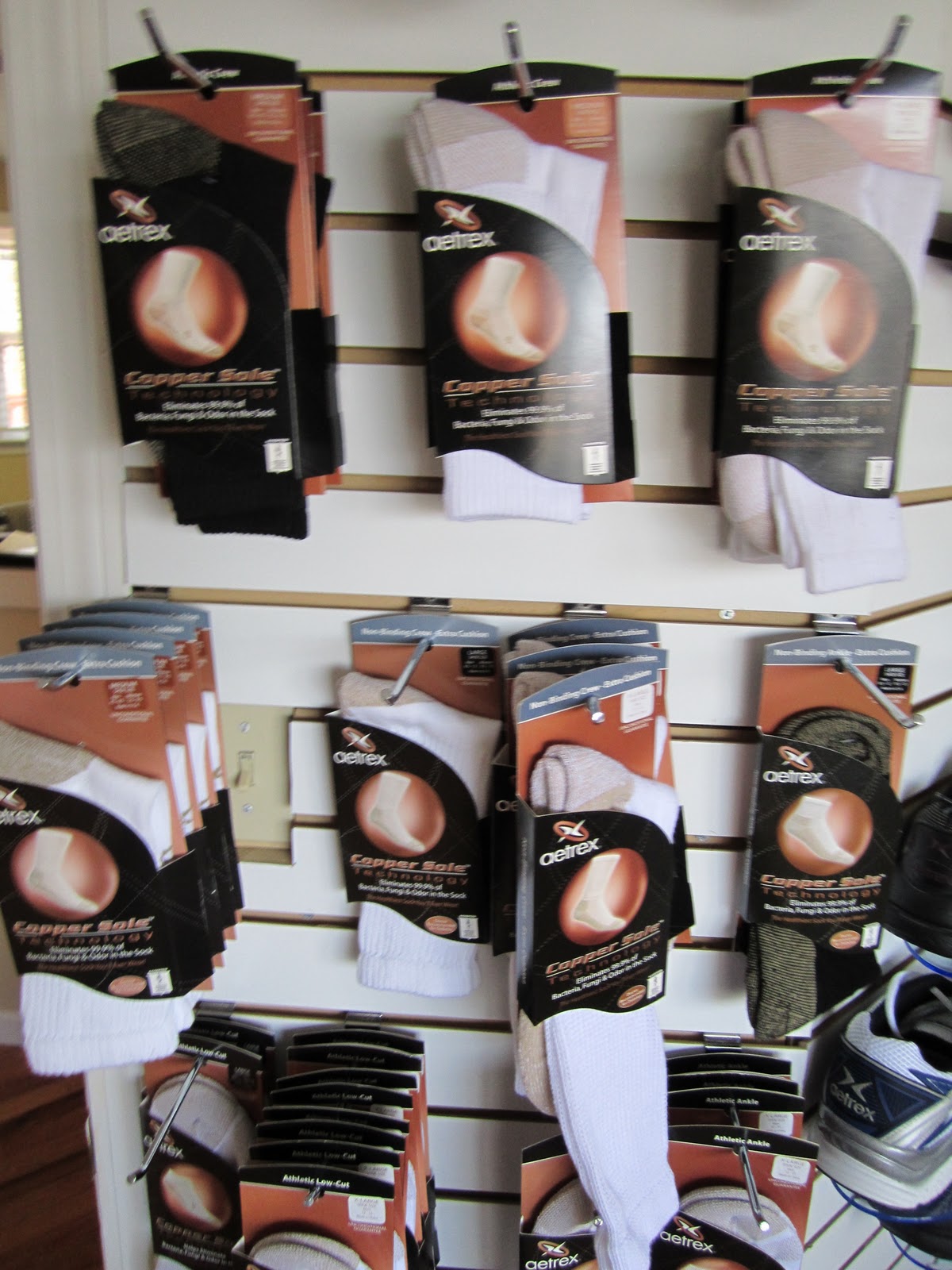
 Copper socks, a popular product.
 Our newest room, the procedure room.
 One of our two non-handicapped exam rooms.
Our digital x-ray machine.

Dr. Tina A. Boucher, DPM
Central Connecticut Foot Care, LLC
Podiatrist Meriden CT
http://www.centralctfootcare.com/
Order your free copy of our books "Why Do My Feet Hurt?" and "Heal My Heel!" today!

Tuesday, March 29, 2011

Ankle Sprains and Fractures

An ankle sprain is an injury to one or more ligaments in the ankle, usually on the outside of the ankle. Ligaments are bands of tissue- like rubber bands- that connect one bone to another and bind the joints together. In the ankle joint, ligaments provide stability by limiting side-by-side movement. However, not all ankle injuries are sprains; they can be fractures of bone, fractures of cartilage, or even torn tendons or ligaments.
In children, ankle injuries can be growth plate injuries. Ankle injuries often result from a fall, a sudden twist, or a blow that forces the ankle out of its normal position. Anke sprains commonly occur while participating in sports, wearing inappropriate shoes, or walking or running on an uneven surface. The signs and symptoms of ankle sprains may include: pain or soreness, swelling, bruising, difficulty walking, and stiffness in the joint. All ankle injuries need professional attention; neglecting them can lead to more serious problems. These problems can be avoided by prompt diagnosis and treatment.
Not treating an acute ankle sprain can lead to problems. When one sprains their ankle, the ligaments stretch. In fact, there are micro-tears of the ligament fibers. If not treated immediately, scar tissue can form between these torn fibers. This will lead to a very tight and painful ankle and makes it more difficult to treat.
In evaluating your injury, your podiatrist will obtain a thorough history of your pain and examine your foot. You will likely have X-Rays taken as well. Your podiatrist will also recommend R.I.C.E- Rest, Ice, Compression, and Elevation for your treatment, as well as physical therapy and pain medications. Surgery is only typically required in very extreme cases.
Dr. Tina A. Boucher, DPM
Central Connecticut Foot Care, LLC
Podiatrist Meriden CT
http://www.centralctfootcare.com/
Order Your Free Copy of "Why Do My Feet Hurt" or "Heal My Heel" today!

Spring Running Shoe Guide

Fitness Magazine recently surveyed women on the latest running shoes for spring. Nine shoes were finalists.

1. The Best Neutral Running Shoes: Adidas Supernova Glide 3. This shoes is best for people with high arches because it provides maximum cushioning and minimal support. Testers found it to be an overwhelmingly soft shoe with tons of cushioning that takes the pounding for you. The shoe has a two-part heel design with subtle arch support and strategic flex grooves on the outsole. Supportive and responsive with every step, the breathable open-mesh upper keeps your feet comfortable temperature-wise. Price: $110.
2. The Best Neutral Running Shoe Runner Up: Karhu Fast Fulcrum Ride. This shoe looks fast and feels light and quick on your feet. The outsole is relatively flexible, like a racing shoe's and special technology within the midsole uses greater firmness to create an efficient strike and encourage you to land on your midfoot. The mesh upper, welded lace eyelets, and seamless construction around the heel creates a bedroom slipper cushiness. Price: $130.
3. The Best Midstability Running Shoes: Nike LunarElite + 2. Designed for the average strider who slightly overpronates, this shoe has high marks for the wedge support that kicks in when you start to overpronate, providing you with better stability. These shoes are superlight, cushiony, and have strategically placed flex grooves on the outsoles that make you feel like you're running on air. Price: $100.
4. The Best Midstability Running Shoes Runner Up: Brooks Trance 10. Testers found it remarkably cushioned with a trampoline bounce effect with every stride. The shoe disperses impact evenly, leaving your joints feeling fine post-run. The midsole gets progressively denser toward the inner curve of your foot, offering a significant amount of support and prevents your arch from flattening and turning inward as you land. The mesh upper and sock liner make for a comfortable fit. Price: $140.
5. The Best Extra Stability Running Shoes: Asics Gel-Evolution 6. This shoe is for those with flat arches and have feet that turn inwards. If you are a flat-footed, over-pronator, then this shoe is going to feel like heaven. Its dense midsole provides good stability and great shock absorption, and details like a wider midfoot; a soft, wicking sock liner; and a stretchy upper that does not rub or irritate at all mean that the shoe cradles your foot in a comfy, pleasant way while you run. Price: $120.
6. The Best Extra Stability Running Shoes Runner-Up: New Balance 940. Testers state that they ran free with this shoe on and stability was fantastic. A special thermoplastic in the midsole provides smooth transitions through each step and extra shock absorbing cushioning in the heel and forefoot helps you feel like you've got a built-in spring. Its seamless sock liner and mesh upper hug your foot perfectly. Available in four widths to provide the best fit for your foot. Price: $120.
7. The Best Trail Running Shoes: Brooks Cascadia 6. This shoe is going to provide the best footing on uneven terrain. It is a flexible, yet stable, lightweight yet well cushioned shoes that makes it great on every type of terrain, including sand, snow, and loose rocks. Testimonials say that you'll feel like you can conquer the toughest trails with its incredible traction, breathable, water-resistant upper, thermoplastic rock shield beneath the forefoot, and stabilizing pivot posts in the midsole. Price: $110.
8. The Best Trail Running Shoes Runner-Up: Salomon XR CrossMax Neutral. This is a flashy, lightweight runner. Rocks beware! With this shoe, you won't even feel them. The durable outsole grips the trails, and the cushioning is wonderful thanks to molded EVA foam midsoles and orthotic-like (that's what we like to see!) foot beds. A very comfortable fit is what testers say, guaranteed by its airy mesh upper, gusseted tongue, and friction free eyelets. Price: $130.
Dr. Tina A. Boucher, DPM
Central Connecticut Foot Care, LLC
Podiatrist Meriden CT
http://www.centralctfootcare.com/
Order your free copy of "Why Do My Feet Hurt?" or "Heal My Heel!" today!

Thursday, March 24, 2011

Product of the Month: Heel Fissure Packs

If you are looking to get your feet in tip-top shape for the spring and summer sandal season, or to get your feet feeling healthy again, try our new heel fissure packs. Designed for patients with deep cracks, callouses, and dry, scaly skin, this pack contains two products: Gormel Creme and Healthy Feet Buffing Pad. Gormel Creme is designed specifically for those with dry, cracked, and rough skin. It adds elasticity to your skin, making it feel smooth and soft. The Healthy Feet Buffing Pad breaks down the dry, cracked skin thus, helping the Gormel Creme work its best. Between the months of March and April, take $2 off. Must mention this blog post to get discount.
Dr. Tina A. Boucher, DPM
Central Connecticut Foot Care, LLC
Podiatrist Meriden CT
http://www.centralctfootcare.com

Shoe of the Month: Sling Backs

Dynamic and sexy, sling backs exude the confident energy of those who wear them. Find a sling back with a lower heel so they can be worn from day to night. Make sure straps aren't too tight, as that could lead to chafing on the back of the heel, and conversely, make sure they aren't too loose, so that straps are not constantly being pulled up. Foot Petals' Strappy Strips, approved by the APMA, can be placed on the inside of straps to prevent them from cutting into or sliding down the heel.

Dr. Tina A. Boucher, DPM
Central Connecticut Foot Care, LLC
Podiatrist Meriden CT
http://www.centralctfootcare.com

Tuesday, January 25, 2011

Foot Pain Making 72% of Americans Fat

From the American Podiatric Medical Association:

Bethesda, MD – A staggering 72 percent of Americans say they do not exercise because foot pain prevents them from doing so, according to a recent survey by the American Podiatric Medical Association (APMA). This finding, when viewed in light of the soaring rates of US obesity as reported by the Centers for Disease Control, makes visiting a podiatrist and addressing foot pain critically important.


The study surveyed 1,000 US adults, ages 18 and older, to gain public opinion on attitudes toward foot health and foot care. Results showed that Americans view their feet as the least important body part in terms of their health and well-being. However, feet were the number one body part to experience pain, even more so than the teeth or skin. As foot pain contributes to a variety of negative health consequences, it is important that Americans seek the care of a podiatrist immediately if problems arise.

The survey results support the launch of the Today’s Podiatrist campaign, which increases awareness about the specialized medical training and unique qualifications a podiatrist has in treating the foot and ankle.

“Podiatrists are physicians, surgeons and specialists who treat diseases, injuries and deformities of the foot and ankle,” said APMA president Kathleen Stone, DPM. “We should be part of everyone’s health-care team, but it is especially important for those experiencing regular foot pain to seek care from a podiatrist.”

It is critical that people pay attention to their feet and seek expert treatment for foot problems. A podiatrist can not only help ensure Americans are able to exercise, but also help catch signs of diabetes, arthritis, and nerve and circulatory disorders, which can all be detected in the feet.

Dr. Tina A. Boucher, DPM
Central Connecticut Foot Care, LLC
Podiatrist Meriden CT
http://www.centralctfootcare.com

Wednesday, January 19, 2011

Flaking, Red Skin on My Feet!

Although it is winter out, you can still have flaking, itchy, red skin on your feet. This condition is more commonly known as Athlete's foot, or tinea pedis, and while this condition is more prevalent in the warm months, you can get Athlete's foot in the cold winter months. Athlete's foot is caused by a fungal infection. Our feet typically tend to get fungal infections because fungus breeds in dark, moist, warm environments and our shoes are a perfect place for it to grow. Fungus also loves to grow in places like swimming pools, showers, and locker rooms. In fact, athletes are so prone to Athlete's foot that was partly how it got its name! Athlete's foot is the most common fungal infection of the skin and can often go hand-in-hand with fungal toenails.
Besides the itchy, scaly, dry skin, Athlete's foot loves the feet of those who sweat a lot. This condition tends to occur on the bottoms of our feet and in between the toes. Those with acute problems may experience blisters or fissures. If the blisters break the fungus is likely to spread to other parts of the foot, as fungus is highly contagious. The burning and itching that goes with blisters may be relieved by draining the blisters or applying cool water compresses. Prolonged Athlete's foot infections may cause secondary bacterial infections.
Podiatrists diagnose Athlete's foot from a clinical examination. Doctors looking for a more definitive diagnosis may scrape the affected area and culture the fungus, which can take up to three weeks for it to grow. Culturing is not always the best method of determining if Athlete's foot is present as it can produce a false negative result because the scraping was not sufficient.
Your podiatrist will seek to control the fungal infection and prevent any secondary infection from occurring. Oral antibiotics will be prescribed, as well as soaking the feet in Epsom salts and warm water, and thoroughly drying the feet, especially between the toes.  In the warmer months, wearing sandals to reduce moisture accumulation will be helpful. If you have feet that sweat a lot, you should change your socks often throughout the day. There are also antifungal powders, sprays, and/or creams that may be helpful in your particular case.
Dr. Tina A. Boucher, DPM
Central Connecticut Foot Care, LLC
Podiatrist Meriden CT
http://www.centralctfootcare.com

January Shoe of the Month: Pumps

The perfect pumps is always classy and never goes out of style. Ageless and refined, it comes in many styles, including the ever-fierce stiletto. Be aware if pumps are too pointy, the pressure placed on toes over time can contribute to unsightly bony prominences called hammertoes or bumps at the base of the big toe called bunions. Search for deep toe boxes, which give more wiggle room. And of course, see a podiatrist if pain exists to determine necessary treatment options.
A personal favorite is Triple Play in leopard print, available from Aerosoles and currently on clearance. Comfortable, stylish, and easy to walk in, this shoe is perfect for a night out on the town!

Dr. Tina A. Boucher, DPM

Central Connecticut Foot Care, LLC

Podiatrist

http://www.centralctfootcare.com

Tuesday, January 4, 2011

A Knot In My Foot!

Have you noticed a lump in your arch that may be causing you pain? Has this lump grown in size or have you found other lumps in the same general area?

You most likely have a plantar fibroma which is found in the plantar fascia, which runs from your heel to your toes. Fibromas can be located in both of your feet and typically will not go away or reduce in size without treatment. Most importantly, plantar fibromas are benign. Podiatrists have not been able to determine definite causes for plantar fibromas.


Those with plantar fibromas may not have pain, but those who may find that pain is caused by shoes rubbing against the lump.


To determine ifwhat you have is indeed a plantar fibroma, a podiatrist will need to perform an examination of the affected area. During this examination you may experience pain that extends into your toes. A podiatrist may also need an MRI or biopsy to further confirm the diagnosis.


The only way to truly get rid of a plantar fibroma is through surgery, but this may cause the arch of the foot to collapse and promote the development of hammertoes. Most fibromas are treated with nonsurgical treatment. These treatment options include:


Orthotic Devices: Orthotics will help alleviate the pain caused by your fibroma by shifting the weight away from the mass. Orthotics can only be prescribed if the size of the fibroma has not changed.


Steroid Injections: An injection at the site will help decrease the size of the lump. An injection will also help reduce the pain associated with the mass. However, the relief and reduction of the fibroma can be temporary and it can return to its original size and pain.


Physical Therapy: The pain can be treated through physical therapy methods that transmit anti-inflammatory medication directly to the site.


Follow-up is key to treating a fibroma, so make sure to keep your appointments with your podiatrist.


Dr. Tina A. Boucher, DPMCentral Connecticut Foot Care, LLC Podiatristhttp://www.centralctfootcare.com

Monday, December 27, 2010

Today's Podiatrist

Have you heard about Today's Podiatrist?

There are 16,450 licensed podiatrists in the United States, 75% of whom are members of the American Podiatric Medical Association. The APMA has launched a new program to educate patients about who today's podiatrists are. This is especially important when 75% of all people will experience some kind of foot or ankle pain in their lifetime. Informed patients make informed decisions!

When you suffer from foot or ankle pain, it can sometimes be an indication of other, more serious problems throughout your entire body. Diabetes, arthritis, and nerve problems can be detected from foot problems.

Podiatrists are not just people who cut toenails or cut down callouses. Podiatrists are doctors, surgeons, and specialists who have years of training and experience. Podiatrists perform more foot and ankle surgeries than any other medical profession. Studies have found that diabetics who go to a podiatrist for their foot health greatly reduce their risk of amputation.

We at Central Connecticut Foot Care Center and Dr. Tina A. Boucher, DPM, in Meriden, CT, are proud to be one of Today's Podiatrists, performing state of the art medicine every day. Check out our website, http://www.centralctfootcare.com/, which has a section devoted to Today's Podiatrist. There you will find a YouTube video http://www.youtube.com/watch?v=aHSbeTJUcCM&feature=player_embedded on podiatrists, a downloadable sheet on what to expect at your visit, and helpful information on foot and ankle conditions.

Dr. Tina A. Boucher, DPM
Central Connecticut Foot Care, LLC
Podiatrist Meriden CT
http://www.centralctfootcare.com