If you are a patient with diabetes, you may want to talk to your podiatrist about diabetic neuropathy. Neuropathies are a family of nerve disorders that can be caused by diabetes. People with diabetes can, over time, develop nerve damage throughout the body. Some people with nerve damage have no symptoms. Others may have symptoms such as pain, tingling, or numbness- loss of feeling- in the hands, arms, feet, and legs. Diabetic neuropathies often manifest in your feet and may even be the first sign that you have developed diabetes.
The longer you live with diabetes, the more likely it is that you may develop neuropathy. Furthermore, this problem becomes magnified if you have difficulty controlling your blood sugars. However, some patients with diabetes never develop neuropathy and have no symptoms at all. Mild cases of neuropathy may go unnoticed for many years- and remain untreated. Symptoms of numbness, tingling, or burning should be brought to the attention of your podiatrist as there may be treatments available to help alleviate these sensations.
If you and your podiatrist discover that you do have neuropathy, there are a number of things you can do to keep your feet healthy:
*Check your feet every day and if necessary, use a mirror to view the bottoms and sides of your feet. Call your podiatrist at the first sign of swelling, redness, cuts, infection, or abnormalities.
*Make sure that your shoes are free of any debris before sliding them on. Even a tiny stone can cause damage.
*Have your primary care physician check your feet during each general visit. If a problem is identified, the physician will refer you to your podiatrist.
*Choose the right shoes. Shoes that are too tight or that rub can cause serious problems that can develop into serious health concerns.
*Wear white or light colored socks so that you can see if any blood or fluid from a sore may have developed during the day.
*Always wash your feet in lukewarm water. Dry them carefully, especially between your toes, and use products such as creams and powders that have been approved by your podiatrist or have the APMA Seal of Approval.
*Do not walk barefoot, even at home. You never know what may be lurking on your floors and in your carpets.
*Visit your podiatrist frequently to make sure that your diabetes is under control and that your feet stay healthy.
Dr. Tina A. Boucher, DPM
Central Connecticut Foot Care, LLC
Podiatrist Meriden CT
http://www.centralctfootcare.com/
Order your free copy of our books "Why Do My Feet Hurt?" and "Heal My Heel!" today! Copies will be sent to Connecticut residents only.
Friday, November 4, 2011

Thursday, November 3, 2011
Knock your Socks Off!
 November is Diabetes Awareness Month and Central Connecticut Foot Care Center is dedicated to helping educate our patients and the community about this epidemic.
According to the American Diabetes Association, nearly 12% of the Hispanic population has diabetes and 66% are at risk of developing the disease when compared to other ethnic groups. When it comes to your feet, diabetes is a very dangerous disease and should not be ignored. Even if you have your diabetes under control, you should see a podiatrist for routine diabetic foot care. Diabetes is the leading cause of non-traumatic lower-limb amputations and with proper care, most amputations can be avoided.
Think you know a lot about diabetes? Take this quiz created by the American Podiatric Medical Association to test your knowledge!
Dr. Tina A. Boucher, DPM
Central Connecticut Foot Care, LLC
Podiatrist Meriden CT
http://www.centralctfootcare.com
Order your free copy of our books "Why Do My Feet Hurt?" and "Heal My Heel!" today! Copies will be sent to Connecticut residents only.
Monday, October 31, 2011
Orthotics: What Are They?
Orthotics are custom molded devices which are designed specifically for your feet and then placed in your shoes. They are intended to correct abnormal foot biomechanics. They perform functions that make standing, walking, and running more comfortable and efficient by altering the angles at which the foot strikes a walking or running surface. Doctors of podiatric medicine prescribe orthotics as a conservative approach to many foot problems or as a method of control after certain types of foot surgery; their use is a highly successful, practical form of treatment.
Orthotics take various forms and are constructed of various materials. They fall into three broad categories: those that primarily attempt to change foot function, those that are primarily protective in nature, and those that combine functional control and protection. Orthotics can be categorized as rigid, semi-rigid, and soft.
 The so-called rigid orthotic device, designed to control function, may be made of a firm material such as plastic or carbon fiber and is used primarily for walking or dress shoes. It is generally fabricated from a plaster mold of the individual foot. The finished device normally extends along the sole from the heel to the ball of toes of the foot. It is worn mostly in closed shoes with a heel height under two inches.
Dr. Tina A. Boucher, DPM
Central Connecticut Foot Care, LLC
Podiatrist Meriden CT
http://www.centralctfootcare.com/
Order your free copy of our books "Why Do My Feet Hurt?" and "Heal My Heel!" today! Copies will be sent to Connecticut residents only.
Orthotics take various forms and are constructed of various materials. They fall into three broad categories: those that primarily attempt to change foot function, those that are primarily protective in nature, and those that combine functional control and protection. Orthotics can be categorized as rigid, semi-rigid, and soft.
 The so-called rigid orthotic device, designed to control function, may be made of a firm material such as plastic or carbon fiber and is used primarily for walking or dress shoes. It is generally fabricated from a plaster mold of the individual foot. The finished device normally extends along the sole from the heel to the ball of toes of the foot. It is worn mostly in closed shoes with a heel height under two inches.
The semi-rigid orthotic provides for dynamic balance of the foot while walking or participating in sports. Each sport has its own demands and each sport orthotic needs to constructed appropriately with the specific sport and athlete in mind. This functional dynamic orthotic helps guide the foot through proper functions, allowing the muscles and tendons to perform more efficiently. The classic semi-rigid orthotic is constructed of layers of soft materla, reinforced with more rigid materials.
The soft orthotic device helps to absorb shock, increase balance, and take pressure off uncomfortable or sore spots. It is usually constructed of soft, compressible materials, and may be molded by the action of the foot in walking or fashioned over a plaster impression of the foot. This orthotic usually extends from the heel past the ball of the foot to include the toes. The advantage of any soft orthotic device is that it may be easily adjusted to changing weight-bearing forces. The disadvantage is that it must be periodically replaced or refurbished.
Various other orthotics may be used for multidirectional sports or edge-control sports by casting the foot within the ski boot, ice skate boot, or inline skate boot. Combinations of semi-flexible material and soft material to accomodate painful areas are utilized for specific problems.
Only a licensed health care professional can diagnose and prescribe medical treatments, including orthotics. There are some outstanding over-the-counter products which your podiatrist may recommend as an interim treatment, but remember that you will want the advice of your doctor before buying these devices from a retail store, since wearing the wrong type of insert can be detrimental to feet, especially for people with diabetes or arthritis. Dr. Tina A. Boucher, DPM
Central Connecticut Foot Care, LLC
Podiatrist Meriden CT
http://www.centralctfootcare.com/
Order your free copy of our books "Why Do My Feet Hurt?" and "Heal My Heel!" today! Copies will be sent to Connecticut residents only.
Thursday, October 27, 2011
Should I Go To the ER?
 Foot and ankle trauma is all too common in the fall when kids go back to school and participate in fal sports. In addition, many of us ramp up our exercise regimens as temperatures become more moderate. When faced with what to do and where to go for foot and ankle injuries such as a twisted ankle, broken toe, or open laceration, here are some tips:
*Today's podiatrists have been educated and trained to diagnose and treat injuries of the foot and ankle.
*Most foot and ankle injuries can be evaluated and treated by the podiatrist in his or her office, saving a trip to the emergency room.
*Most podiatrists have X-ray equipment in their offices, so they can determine if your foot or ankle is fractured or just sprained.
*If you decide to go to an emergency room, ask to see a podiatrist.
Wait times and insurance co-payments are often less in your podiatrist's office than in an emergency room. If in doubt, call your podiatrist to determine where you should go if you injure your foot or ankle. Dr. Tina A. Boucher, DPM
Central Connecticut Foot Care, LLC
Podiatrist Meriden CT
http://www.centralctfootcare.com/
Order your free copy of our books "Why Do My Feet Hurt?" and "Heal My Heel!" today! Copies will be sent to Connecticut residents only.
Thursday, September 22, 2011
ING Hartford Marathon
 On a crisp fall morning at 8AM, more than 10,000 people will wait for the sound of horn. Some have been preparing for this event all their lives, while some are brand new and have just begun this year. No matter what level, this is a major event in their careers. 45,000 people will wait, watch, and cheer them on in a race to the finish.
Running careers, that is. October 15, 2011 is the ING Hartford Marathon and Half Marathon, an event which three of our patients will take part in. The full marathon will take runners through Hartford, East Hartford, and South Windsor, while half marathon runners will travel through Hartford and West Hartford.
There are many opportunities to volunteer at the race, with jobs ranging from course clean-up to selling merchanidise. Runners may also chose to run for a cause, like the American Cancer Society or Jane Do No More. We wish all of our patients who are running the best of luck, good times, and healthy feet!
Dr. Tina A. Boucher, DPM
Central Connecticut Foot Care, LLC
Podiatrist Meriden CT
http://www.centralctfootcare.com/
Order your free copy of our books "Why Do My Feet Hurt?" and "Heal My Heel!" today! Copies will be sent to Connecticut residents only.
Thursday, September 15, 2011
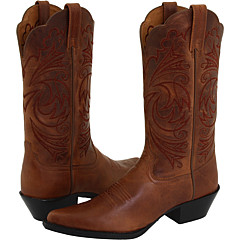
Boots Day by Day: Wednesday
Style: Classic Cowboy Boots
Problem: Narrow toebox can caused blistered and cramped toes.
Solution: Wear only for short periods of time and allow toes to stretch.
Our recommendation: Ariat Heritage Western Russet Rebel. Available from http://www.zappos.com/. $169.95.
 Dr. Tina A. Boucher, DPM
Central Connecticut Foot Care, LLC
Podiatrist Meriden CT
http://www.centralctfootcare.com/
Order your free copy of our books "Why Do My Feet Hurt?" and "Heal My Heel!" today! Copies will be sent to Connecticut residents only.
Problem: Narrow toebox can caused blistered and cramped toes.
Solution: Wear only for short periods of time and allow toes to stretch.
Our recommendation: Ariat Heritage Western Russet Rebel. Available from http://www.zappos.com/. $169.95.
Central Connecticut Foot Care, LLC
Podiatrist Meriden CT
http://www.centralctfootcare.com/
Order your free copy of our books "Why Do My Feet Hurt?" and "Heal My Heel!" today! Copies will be sent to Connecticut residents only.
Tuesday, September 13, 2011
Boots Day by Day: Tuesday
Style: Playful Rain Boot
Problem: Rigid shape limits natural foot movement and provides no arch support.
Solution: Try cushioned insoles and arch supports.
Our recommendation: Land's End Wellie Boot. Available from http://www.landsend.com/. $69.50
 Dr. Tina A. Boucher, DPM
Central Connecticut Foot Care, LLC
Podiatrist Meriden CT
http://www.centralctfootcare.com/
Order your free copy of our books "Why Do My Feet Hurt?" and "Heal My Heel!" today! Copies will be sent to Connecticut residents only.
Problem: Rigid shape limits natural foot movement and provides no arch support.
Solution: Try cushioned insoles and arch supports.
Our recommendation: Land's End Wellie Boot. Available from http://www.landsend.com/. $69.50

Central Connecticut Foot Care, LLC
Podiatrist Meriden CT
http://www.centralctfootcare.com/
Order your free copy of our books "Why Do My Feet Hurt?" and "Heal My Heel!" today! Copies will be sent to Connecticut residents only.
Subscribe to:
Posts (Atom)