Wednesday, June 23, 2010

Capsulitis and Your Foot

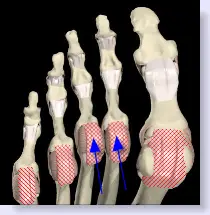
In our second toe, there are ligaments that surround the joints at the base of the toe, forming what are called capsules. Capsulitis is an inflammation of these capsules. While capsulitis can affect your third or fourth toes, it most commonly affects the second toe. Capsulitis can also be known as predislocation syndrome, due to the fact that if the condition is left untreated, it can lead to a weakening of surrounding ligaments and cause a dislocation of the toe.
Capsulitis in your foot is thought to be caused by abnormal foot mechanics, especially when the ball of the foot takes a great deal of weight-bearing pressure. Other conditions may predispose you to capsulitis, including bunion deformities, your second toe being longer than your big toe, an unstable arch of your foot, or a tight calf muscle.
Capsulitis is a degenerative disease and therefore should be treated as soon as you notice the condition. Symptoms in the early stages may include:
1. Pain in the ball of your foot, almost like there is a bunched up sock .
2. Swelling in the area.
3. Difficulty wearing or putting on your normal shoes.
4. Pain when in barefeet.
In more advanced cases, the affected toe may start to drift over to the big toe and cross over.
This condition may often be confused with Morton's Neuroma, which has similar symptoms, so it is crucial that you get an accurate diagnosis from a podiatrist. Your podiatrist will manipulate the affected area to produce symptoms and X-rays will be ordered.
Will you need surgery? Not if it is caught in the early stages before it crosses over. Once it has crossed over, the toe will never go back to its original place and will need to be surgically corrected. Things that can be done prior to that are:
1. Rest and Ice.
2. Anti-inflammatory medications, like ibuprofen.
3. Taping and splinting.
4. Stretching.
5. Shoe modifications.
6. Orthotic devices.
Always contact your podiatrist first when you think you have capsulitis in your foot!
Dr. Tina A. Boucher, DPM
Central Connecticut Foot Care, LLC
Meriden, CT Podiatrist
http://www.centralctfootcare.com/
Order your copy of our free books "Why Do My Feet Hurt?" and "Heal My Heel!" today!

Tuesday, June 8, 2010

Shoe of the Month: Flip Flops

Here at Central Connecticut Foot Care Center, we are not generally fans of the flip flop. Every September and October we see an amazing amount of patients with symptoms of heel pain because they have worn flip flops all summer. For the most part, flip flops should not be part of your shoe wardrobe because they have no arch support and damage your feet.
Even the most intuitive person may have trouble deciding between the countless flip-flop color and style choices. Select a pair that has some support and is unable to bend in half to minimize foot pain often caused by flip-flops. Blisters are typically caused by poor-fitting straps, so choose a style made of natural materials, such as soft leather, and make sure the foot does not hang off the edge. Heel pain sufferers should avoid flip-flops.
However, there are a few exceptions to this rule. Moszkito flip flops are one of the brands we recommend and sell in our office. We also recommend the Aetrex Montserrat flip-flop, available for purchase soon in our office as part of the Aetrex Foot Wear System.

Dr. Tina A. Boucher, DPM
Central Connecticut Foot Care, LLC
Meriden, CT Podiatrist
http://www.centralctfootcare.com/
Order your free copy of our books "Why Do My Feet Hurt?" and "Heal My Heel!" today!

Product of the Month: Dr.'s Remedy Nail Polish

It is summer and your digits on your feet want to show off. But what do you do if you have ugly fungus toe nails? One product you can use is Dr.'s Remedy Enriched Nail Polish. The polish acts as a anti-fungal medication for your diseased nails and as a way to cover up those unsightly nails as well. Dr.'s Remedy is made with Vitamins C and E to promote healthier skin and nails, and wheat protein which contains protein and amino acids. It is a natural polish with tea tree oil and garlic bulb extract, which are naturally occurring anti-fungal ingredients. What's not in this product is formaldehyde, a chemical that has been proven to cause cancer, DBPs, a potential development and reproductive toxin that may cause birth defects (it is even banned in Europe!), and toluene, a chemical that the EPA restricts in our drinking water; it can cause nervous system disorders and damage to the liver and kidneys.
We sell Dr.'s Remedy Enriched Nail Polish in many colors, including their 2010 line: Vigor (Violet), Brilliant (Blue), Lively (Lilac), as well as reds and pinks. Visit www.remedynails.com to check out their complete line of nail polishes. Now through July 31, 2010, get $2 off the price of each Dr.’s Remedy Nail Polish in our office only. You must mention this newsletter in order to get the discount. You can also save yourself a trip to our office and purchase this nail polish through our Dr. Store, located on our website, www.centralctfootcare.com.

Dr. Tina A. Boucher, DPM
Central Connecticut Foot Care, LLC
Meriden, CT Podiatrist
http://www.centralctfootcare.com/
Order your free copy of our books "Why Do My Feet Hurt?" and "Heal My Heel!" today!

Wednesday, May 26, 2010

Arthritis and the Foot

In the past couple of days I have diagnosed several cases of arthritis in the foot. You may think that getting arthritis in the foot is an uncommon problem, but since there are many joints in the foot, it is a prime place for it to occur.

Over 30 million Americans suffer from arthritis in all parts of their body and while adults are the major sufferers of the disease, children can have this condition as well. Arthritis means that the cartilage and lining of your joints is swollen and inflammed.

Just like your hands, which have many joints and are a common affected area, feet have a similar likelihood because of the number of joints.

There are two types of arthritis: osteoarthritis and rheumotoid arthritis. Osteoarthritis is found in many older patients, but younger patients may have this condition due to an injury or overuse of a particular joint. The cartilage that covers the end of the bones begins to wear away, especially in weight-bearing joints, and often times bone spurs will develop in those areas. The inflammation from the spurs causes pain and swelling.

Rheumatoid arthritis can be found in people of all ages and is a chronic condition. When treating this ailment, podiatrists seek to provide their patients with pain relief, increase the motion in their joints, and improve strength in those areas.

So what can be done if you suffer from arthritis? There are several treatment options depending on the severity of your condition. Many people will have custom-made orthotics made for their shoes and others use accomodating shoes to alleviate much of the pain associated with the pain. Sometimes treatment can be as simple as rest or modified activity, an anti-inflammation medication, or an arthritis medication.

Dr. Tina A. Boucher, DPM
Central Connecticut Foot Care, LLC
Meriden, CT Podiatrist
http://www.centralctfootcare.com/
Order you free copy of our books "Why Do My Feet Hurt?" and "Heal My Heel!" today!

Tuesday, May 11, 2010

Product of the Month: Moszkito Sandals

In preparation for the warm summer months ahead, try Moszkito Archy Sandals for men or women, sold in our office. Many patients wear flip-flops during the summer season and have debilitating heel pain in the autumn months because of it. So if you are going to wear flip-flips anyway (and we don't recommend wearing anything other than these!) you might as well wear one that has arch support and is fashionable! There are twelve varieties for women and nine varieties for men.

Get $10 off your purchase of Moszkito Archy Sandals during the month of May. Patient must mention blog post to get the discount. Offer ends May 31, 2010.

Dr. Tina A. Boucher, DPM
Central Connecticut Foot Care, LLC
Meriden, CT Podiatrist
http://www.centralctfootcare.com/
Order your free copy of our books "Why Do My Feet Hurt?" and "Heal My Heel!" today!

Thursday, May 6, 2010

National Skin Cancer Month

May is National Skin Cancer Awareness Month, and while you would not think that you can get skin cancer on your feet, it is a possibility. Lathering up your feet is just as important as lathering up your legs, arms, and face.

Checking your feet is a good way for early detection of skin cancer. If an irregular shaped spot appears on your foot, check the rest of your body. Nearly half of the people who have a melanoma on their foot die within five years because the cancer had spread throughout their body. Early detection is KEY!

More than half of the cases of skin cancer on the foot occur in blacks.

There are three key areas to which you should pay attention on your feet: around and under the toenails (a spot that does not go away with time, like a bruised toenail would), the soles, and inbetween the toes.

Remember to look for the ABCDE's of skin cancer:

A: Asymmetry


B: Border


C: Color


D: Diameter


E: Elevation


If you find a mole or spot that fits one or more of these criteria, you should seek the advice of a podiatrist for moles and spots on the foot. For other areas of the body you should visit a dermatologist.


Dr. Tina A. Boucher, DPM
Central Connecticut Foot Care, LLC
Meriden, CT Podiatrist
http://www.centralctfootcare.com/
Order your free copy of our books "Why Do My Feet Hurt?" and "Heal My Heel!" today!

Shoe of the Month: Chunky Heels

It's no wonder fashion's hottest new fotowear staple is none other than the friendly and innovative chunky heel. Known for its relative ease on the feet, the chunky heel offers much more stability than its skinny friend. For best fit, always buy shoes in the afternoon after feet have had time to swell from the day's activities. Buying shoes when feet are at their largest will ensure the best possible fit.


Dr. Tina A. Boucher, DPM
Central Connecticut Foot Care, LLC
Meriden, CT Podiatrist
http://www.centralctfootcare.com/
Order your free copy of our books "Why Do My Feet Hurt?" and "Heal My Heel!" today!